Learning and Evaluation at Nidrana

A structured, transparent approach to understanding participation, impact, and long-term potential in non-clinical, nature-based community spaces.
Hero Background
Hero Background

Why Evaluation Matters

Nidrana is built as a public-interest initiative. This requires more than intention. It requires clarity, accountability, and continuous learning. Our approach to learning and evaluation is designed to understand what works, for whom, and under which conditions. Rather than making assumptions, we observe, document, and refine the model based on real participation and measurable outcomes. Nidrana does not aim to replace clinical systems or claim medical outcomes. Instead, we focus on generating credible, non-clinical evidence that supports prevention, reintegration, and social connection.

Nidrana is built as a public-interest initiative. This requires more than intention. It requires clarity, accountability, and continuous learning. Our approach to learning and evaluation is designed to understand what works, for whom, and under which conditions. Rather than making assumptions, we observe, document, and refine the model based on real participation and measurable outcomes. Nidrana does not aim to replace clinical systems or claim medical outcomes. Instead, we focus on generating credible, non-clinical evidence that supports prevention, reintegration, and social connection.

Nidrana combines quantitative and qualitative methods to create a balanced understanding of impact.


Our evaluation approach is:

  • Non-clinical and community-based

  • Focused on participation and experience

  • Transparent and ethically grounded

  • Designed for learning and improvement

  • Aligned with public funding and research standards


We prioritize clarity over complexity and relevance over abstraction.

A Structured, Evidence-Informed Approach
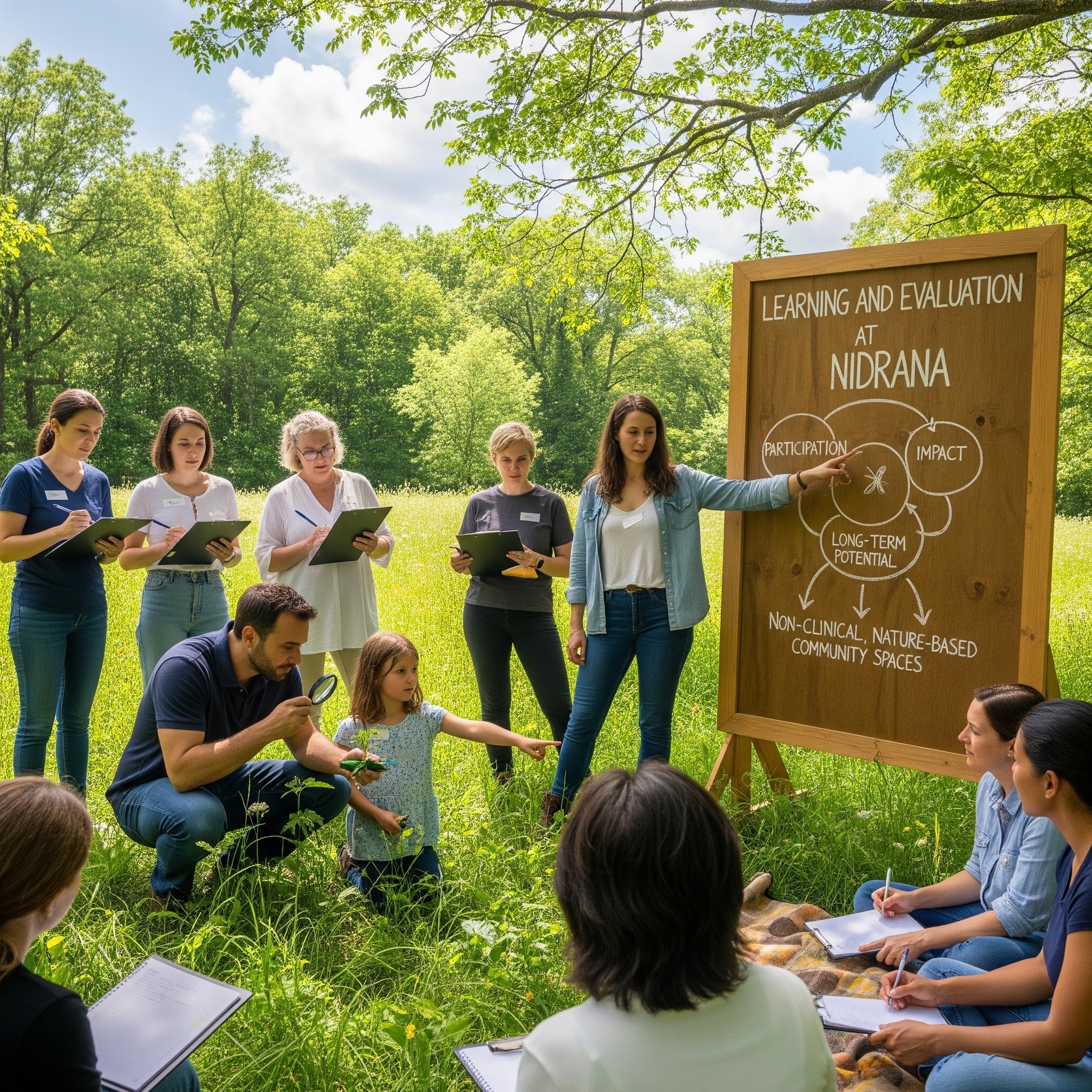

Key Areas of Measurement

Evaluation focuses on outcomes relevant to everyday life and social participation.

Well-being

Changes in subjective well-being over time.

Changes in subjective well-being over time.

Perceived Stress

Perceived Stress

How participants experience stress in daily life.

How participants experience stress in daily life.

Loneliness

Loneliness

Levels of perceived social isolation.

Levels of perceived social isolation.

Sense of Belonging

Connection to others, the group, and the place.

Connection to others, the group, and the place.

Engagement & Participation

Attendance, retention, and continuity.

Attendance, retention, and continuity.

These indicators reflect the core aim of Nidrana:

supporting stable, meaningful participation in everyday life.

Measurement Methods

Nidrana uses a combination of simple, validated tools and direct observation.

Quantitative Measures

Quantitative Measures

  • Short well-being scales

  • Perceived stress assessments

  • Loneliness indicators

  • Custom items related to belonging and place connection


These tools are:

  • easy to complete

  • low burden for participants

  • suitable for non-clinical environments

  • Short well-being scales

  • Perceived stress assessments

  • Loneliness indicators

  • Custom items related to belonging and place connection


These tools are:

  • easy to complete

  • low burden for participants

  • suitable for non-clinical environments

Qualitative Methods

Qualitative Methods

  • Weekly reflection cards

  • Participant interviews

  • Open-ended feedback

  • Facilitator observations


These methods help capture:

  • personal experience

  • changes over time

  • group dynamics

  • perceived value of the space

  • Weekly reflection cards

  • Participant interviews

  • Open-ended feedback

  • Facilitator observations


These methods help capture:

  • personal experience

  • changes over time

  • group dynamics

  • perceived value of the space

Evaluation Timeline

Evaluation takes place at multiple points to understand change over time:

Before participation (baseline)

Before participation (baseline)

Midpoint of the program

Midpoint of the program

End of the program

End of the program

Follow-up after completion

Follow-up after completion

This allows us to assess:

Short-Term Effects

Sustained Changes

Long-Term Relevance

Participation and Behavioural Indicators

In addition to surveys and feedback, we track:

  • Attendance per session

  • Retention rates

  • Dropouts and cancellations

  • Number of completed sessions

  • Interest in continuation

  • Demand indicators such as waiting lists


These metrics are essential for understanding whether the model is:

  • Realistic

  • Accessible

  • Scalable

Hero Background
Hero Background

Nidrana’s evaluation focuses on practical and actionable questions:

Nidrana’s evaluation focuses on practical and actionable questions:

Nidrana’s evaluation focuses on practical and actionable questions:

Key Learning Questions

Key Learning Questions

Key Learning Questions

Impact

Are there measurable changes in well-being, stress, loneliness, and belonging?

Are there measurable changes in well-being, stress, loneliness, and belonging?

Feasibility

Feasibility

Can the model be delivered consistently with available resources?

Can the model be delivered consistently with available resources?

Can the model be delivered consistently with available resources?

Acceptability

Do participants experience the space as safe, welcoming, and accessible?

Do participants experience the space as safe, welcoming, and accessible?

Do participants experience the space as safe, welcoming, and accessible?

Mechanism

What elements contribute most to the experience:

  • Nature

  • Group

  • Creative Activity

  • Repetition

  • Structure

What elements contribute most to the experience:

  • Nature

  • Group

  • Creative Activity

  • Repetition

  • Structure

Demand

Do participants and partners want the model to continue or expand?

Do participants and partners want the model to continue or expand?

Evaluation at Nidrana follows clear ethical principles:

  • Participation is voluntary

  • Data is anonymized and handled according to GDPR

  • No diagnosis or clinical interpretation is made

  • Participants are informed and give consent

  • Safeguarding protocols are in place


Nidrana operates within a non-clinical scope, and evaluation reflects this boundary.

What We Produce

Evaluation results are translated into clear, usable outputs:

  • Pilot evaluation report

  • Participant insight summaries

  • Facilitator learning reports

  • Scalable program framework

  • Recommendations for future implementation


These outputs support:

  • Funders

  • Municipalities

  • Partner Organizations

  • Future Expansion

From Learning to Long-Term Impact

Evaluation is not only about measurement. It is about building a model that can be trusted, replicated, and improved.


Through structured learning, Nidrana aims to:

  • Strengthen prevention-focused approaches

  • Support social cohesion

  • Contribute to public-interest innovation

  • Provide a scalable alternative to fragmented support systems

Work With Us on Research & Evaluation

Work With Us on Research & Evaluation

We welcome collaboration with:

  • Research institutions

  • Universities

  • Public sector partners

  • Evaluation experts

We welcome collaboration with:

  • Research institutions

  • Universities

  • Public sector partners

  • Evaluation experts

Image

Pilot Project

Launching the First Nidrana Pilot in the Netherlands

Nidrana Initiative Foundation is preparing the launch of its first pilot project in the Netherlands. This initial site will serve as a learning environment where the model can be tested, refined, and documented.

Image

Pilot Project

Launching the First Nidrana Pilot in the Netherlands

Nidrana Initiative Foundation is preparing the launch of its first pilot project in the Netherlands. This initial site will serve as a learning environment where the model can be tested, refined, and documented.

Image

Pilot Project

Launching the First Nidrana Pilot in the Netherlands

Nidrana Initiative Foundation is preparing the launch of its first pilot project in the Netherlands. This initial site will serve as a learning environment where the model can be tested, refined, and documented.